
Archives: Nustar Applications

Moving Loads On Rails
As well as the Railway industry itself, rails are often used in manufacturing processes as a method of lowering the rolling resistance of extremely heavy loads.
Often the rails form the basis of the production line itself and loads are moved along the rails from one build cell to the next, into and out of autoclaves and drying kilns or, in and out of maintenance workshops.
Since the wheels fitted to rail bogies, rail cars, wheelsets, transfer cars, and kiln cars are flanged, thereby preventing the load from coming off the rails or, the rail itself is designed in such a way to prevent the wheels from deviating left or right, it is possible to apply a pushing and pulling force both in the centre of the load and also offset to one side of the load. This is particularly useful when there is an inspection pit in place between the rails eg. in a railway maintenance facility.
To safely move the load, it may be temporarily ‘extended’, either to the left or the right, by using an extension bar then enables one of our pushers to apply a pushing force and move the load left–>right or, right–>left.
Moving Loads In Construction
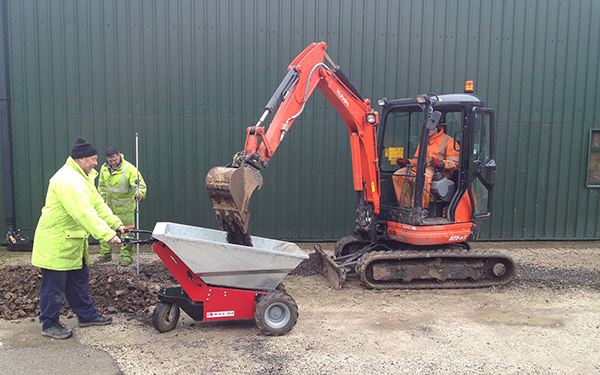
In the Construction industry, loads are not always mounted on wheels/castors and the area in which they are moved is usually not as clearly defined as in a factory, The floor surfaces are often imperfect and, as the project advances, so the landscape of the site changes. These variables present many challenges and it is commonplace to see a much greater use of manual labour across the industry.
Our electric wheelbarrows & powered pushers are all transaxle machines so, are perfectly suited to this environment and, where the loads are not already mounted on wheels or castors, we have developed some specific solutions to temporarily make the load more mobile.
In 2014, we launched our MUV Electric Wheelbarrow machine to safely and efficiently help move concrete, paving slabs, aggregates, flooring screeds and JUST anything else you see moved by a manual wheelbarrow in the Construction industry.
Unlike old-fashioned machines with either petrol or diesel internal combustion engines, Nu-Star electric tugs have no harmful exhaust gas emissions & are virtually noiseless during operation. These features are particularly relevant and beneficial when using a powered wheelbarrow in tunnelling & mining applications & where a contractor is required to move materials on internal sites eg. small works projects at schools, hospitals, airports etc.
Hand-Arm Vibration Syndrome (HAVS) causes the most common industrial injuries in the UK & Employers have a responsibility to identify causes and minimise employee exposure to machinery which causes the injury.
Since our machines are electrically powered, there are no resultant handlebar vibrations to consider in the risk assessment process and therefore operators do not need to be time-limited on our tuggers & wheelbarrows.
Further information here from the HSE: http://www.hse.gov.uk/vibration/hav/index.htm
Professional Builder, May 2015, MUV Electric Wheelbarrow Review
Moving Loads On Skates
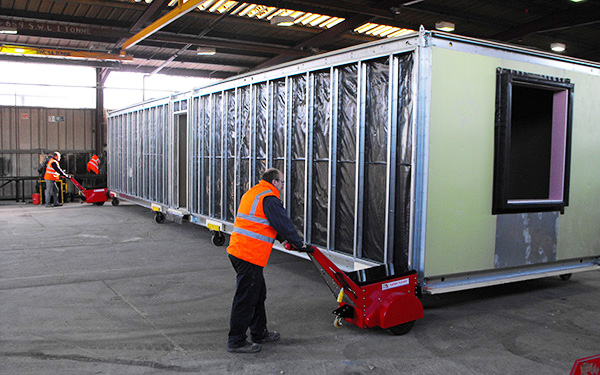
Machinery skates, load moving skates & transport dollies are typically used as a temporary method of making a large heavy object mobile for a specific purpose. They are regularly used by plant and machinery installation & manufacturing companies for the purpose of installing & moving heavy plant and equipment such as Gensets, HVAC units, modular buildings, shipping containers etc.
Once the load has been raised (usually by a hydraulic jack) or, lifted on to the skates by crane, the load can be safely, quickly and easily moved into position with one of our powered pushers, avoiding the high labour costs & manual handling risks of trying to move it manually and the time involved if using a hand winch or turfer.
Nu-Star have a fleet of short term and ‘weekend hire’ pushers which are always available for machinery installation projects. The pushers may be shipped to site by overnight carrier or, collected ex-works. A forklift truck licence is NOT required to operate the machines & a simple push pad or angle bracket attachment handle over 90% of such loads.
Trailer moving equipment
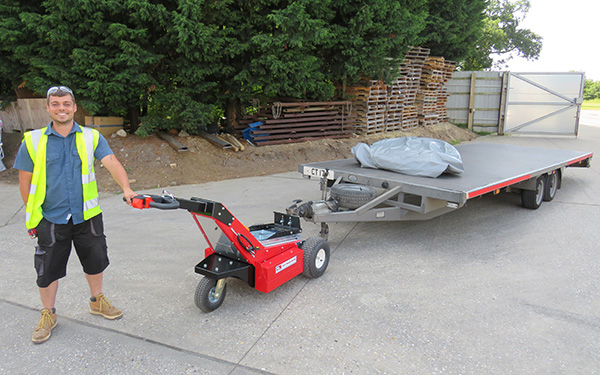
In some instances traditional means to move a trailer by road vehicle or tractor aren’t feasible. This is often due to limited space and a small turning circle or due to restrictions around indoor use and exhaust fumes.
Typical trailer applications and industries where there are limitations are; moving boat trailers, tipper trailers, caravan trailers and moving motorsport trailers. Alternative solutions include; moving trailers by hand, which causes unnecessary and harmful strain on the user or moving trailers using equipment that isn’t fit for purpose, such as by forklift truck.
Nu-Star offer two Trailer Mover models to help you overcome these issues, the electric trailer dollies include; the MUV Trailer Mover, handling loads from 500kg to 2,500kg and the larger model, the HD Trailer Mover handling weights 2,500kg plus.
Our Trailer Movers can be fitted with a range of couplings and hitches, ensuring compatibility across multiple trailer suppliers. The most common towing systems include a tow ball hitch, pintle hitch or towing ring hitch.
Our Trailer Movers are available to buy or hire, contact us for pricing options.
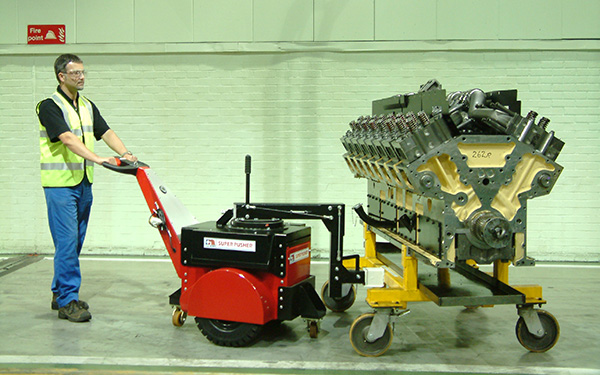
Moving Loads On Trolleys & Carts
A typical industrial trolley has two swivel castors at the ‘front’ and two fixed wheels/castors at the ‘back’. This arrangement requires the trolley to be moved from the ‘front’ and, assuming it is to be moved both forwards and backwards, there needs to be a physical connection to the trolley itself so that it may be steered and to prevent any risk of accidental disconnection.
In order to ‘steer’ the trolley, we use our patented Steering Arm attachment on our tugger carts that incorporates an industrial slewing ring (like a 5th wheel) on top of our machines. This enables the tugger to articulate, relative to the connection to the trolley, and hence the operator can very accurately steer and position the trolley.
The connection to the trolley or cart is achieved by a Male/Female coupling arrangement, which ensures the tug stays safely & securely coupled to the trolley or cart during the movement process. Connection is automatically achieved by driving the machine towards the load & disconnection is by way of a simple pull handle on top of the machine. The Male part of the coupling is on the electric tugger & the Female part of the coupling may be either bolted or welded to the trolley, dolley or cart. The coupling is specifically designed to tolerate ramps & slopes and undulations in the ground.
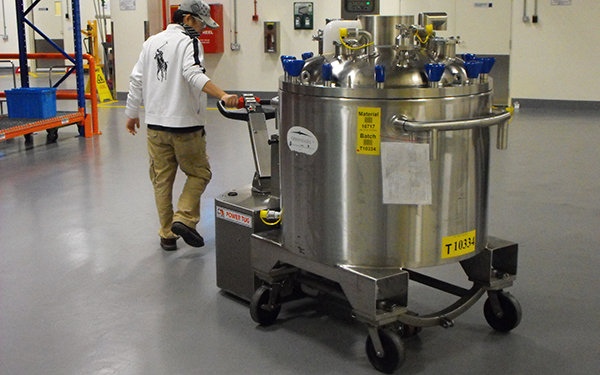
Moving Vessels With Swivel Castors
An industrial load mounted on all swivel castors has the advantage of a very small turning circle, making them highly manouevrable. They are commonly used in the Pharmaceutical industry, the Food industry, Textile industry & Chemical industry during the manufacture and bulk transportation of raw materials and finished product.
The disadvantage is that it is not easy to control in which direction each castor turns as the load is moved (it can behave like a supermarket trolley with a ‘wonky’ wheel). This exaggerates the forces required to both move the vessel and steer the vessel in the intended direction of travel and then position it accurately.
The disadvantage is that because each swivel castor is free to rotate in any direction, the load is highly sensitive to any slopes and cambers on the floor and prone to ‘sliding downhill’ as it is moved. This is a challenge for the manual handling of process vessels and carts as it requires additional upper-body effort not only to move the load but, also to accurately position & steer the load (people often describe it as trying to move a superkarket trolley that has a ‘wonky’ wheel). This often results in even modest sized loads (typically 1,000 – 2,000kg) requiring two or more people to move them safely.
The Nu-Star PowerTug is specifically designed to overcome these issues and enable a single person to both move and accurately steer these type of industrial loads.
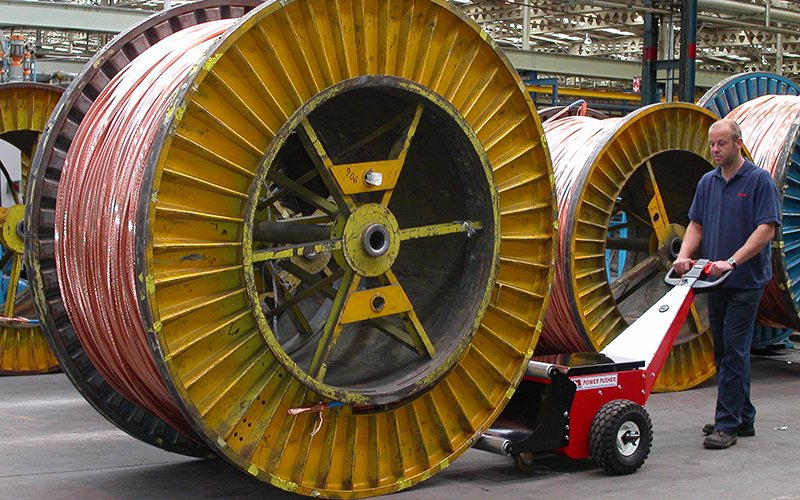
Pushing Cable Drums & Paper Reels
Known in the Cable industry as Drum Pushers and in the Paper industry as Reel Pushers or Roll Movers, Nu-Star offer five different models with push forces ranging from 4,800N right up to 16,700N.
When manufacturing and processing cable and paper, there is often a requirement to move the cable drums and paper or tissue reels into or out of winders, slitters and testing chambers. When there is no overhead crane to effect this movement and a lack of space or, proximity to pedestrians prohibits the use of a clamp truck, staff will often attempt to roll the load manually.
The use of a single pedestrian operated tug unit to push rolls, reels and drums removes the risk of back injury to staff and enables one person to move loads up to 60,000kg – a significant saving as compared to the costs of overhead cranes or, clamp trucks.
N.B. Wooden flanged cable drums are often much more difficult to push, particularly if the wood has become distorted and the drum is no longer ‘circular’ … this is why we give indications for steel flanged drums only. The machines only PUSH a Cable Drum or Paper Roll, they will not PULL and neither will they ‘steer’ such a load.

Moving Loads In Atex Applications
Moving Loads on Rails such as railcars, rail bogies, passenger cars and transfer cars
As well as the Railway industry itself, rails are often used in manufacturing processes as a method of lowering the rolling resistance of extremely heavy loads.
Often the rails form the basis of the production line itself and loads are moved along the rails from one build cell to the next, into and out of autoclaves and drying kilns or, in and out of maintenance workshops.
Since the wheels fitted to rail bogies, rail cars, wheelsets, transfer cars, and kiln cars are flanged, thereby preventing the load from coming off the rails or, the rail itself is designed in such a way to prevent the wheels from deviating left or right, it is possible to apply a pushing and pulling force both in the centre of the load and also offset to one side of the load. This is particularly useful when there is an inspection pit in place between the rails eg. in a railway maintenance facility.
To safely move the load, it may be temporarily ‘extended’, either to the left or the right, by using an extension bar then enables one of our pushers to apply a pushing force and move the load left–>right or, right–>left.